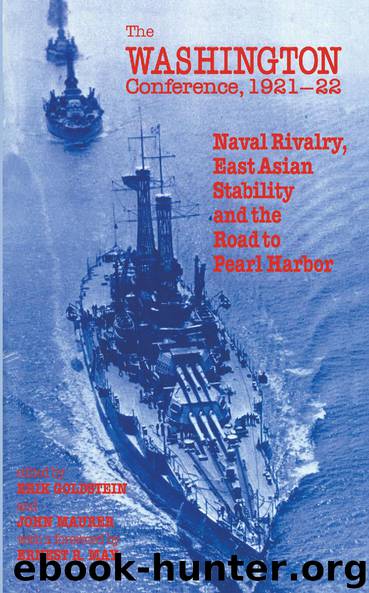
The Washington Conference, 1921-22: Naval Rivalry, East Asian Stability and the Road to Pearl Harbor (Diplomacy & Statecraft) by Erik Goldstein
Author:Erik Goldstein
Language: eng
Format: epub
Publisher: Routledge
Published: 2012-12-06T00:00:00+00:00
The fundamental guideline of American strategy is the principle of the quick-and-decisive battle. It is bent on promptly forcing an encounter with the Japanese fleet and deciding the issue in one stroke.45
However, there were those in the Japanese Navy who questioned whether the American Navy would begin 'a quick westward dash without full preparations'. What if the United States chose to hold back its main fleet until it had secured overwhelming strength and the essential logistic support? In that case, Japanese efforts to keep up the naval ratio vis-à-vis the United States would all come to naught.
To overcome such strategic weaknesses, Kato Kanji, appointed Commander-in-Chief of the Combined Fleet in December 1926, ordered his fleet to conduct relentless night drills. Such were the risks involved that a double collision of four cruisers occurred one moonless night in August 1927, resulting in 120 casualties. After this disaster Admiral Kato grimly addressed the assembled commanders: 'We must devote ourselves more and more to this kind of drill, to which our navy has applied all its energies ever since the acceptance of the 10:10:6 ratio'. This was language calculated to inflame antipathy to the Washington Naval Treaty. The mounting indignation with the 60 per cent ratio had crystallized into the conviction that 'only through these hard drills can we expect to beat America!'46
On the other hand, the United States Navy may, however unwittingly, have added to such antagonism in Japanese naval circles. During the first half of 1925, Admiral Robert E. Coontz, Commander-in-Chief of the United States Fleet, led 56 vessels (including 12 battleships of the Battle Fleet) on a spectacular cruise to Australia and New Zealand.47 Their manoeuvres, on an unprecedented scale, provoked Kato Kanji and his subordinates, who took them to be 'a naked demonstration of American naval buildup against Japan' and a full dress rehearsal for a transpacific offensive.48
The discontent which had been building up among fleet officers ever since the Washington Conference found hyperbolic expression in a letter of protest written later by Admiral Yamamoto Eisuke (not to be confused with Yamamoto Isoroku), who was to be the Commander-in-Chief of the Combined Fleet at the time of the 1930 London Naval Conference. As the nation's 'first line of defence', he protested, the fleet was engaged day and night in relentless exercises to overcome deficient armaments, but the top leaders of the Navy Ministry were all too ready to make 'political compromises' when confronted with budgetary problems, seemingly oblivious to the serious defects in armaments they brought about. These 'moderate leaders' in Tokyo had 'come to resemble civilian desk officers rather than real sailor-warriors'. Venting his 'violent resentment', Admiral Yamamoto traced this 'deplorable' condition to the Washington Conference, Kato Tomosaburo's 'despotic' rule, and his 'emasculation' of the Navy.49
Such strong sentiments bespoke a deep split that had come to plague the Japanese Navy. The late 1920s saw the confluence of two undercurrents that had been building up ever since the Washington Conference. First, there was rivalry and antipathy between the 'fleet
Download
This site does not store any files on its server. We only index and link to content provided by other sites. Please contact the content providers to delete copyright contents if any and email us, we'll remove relevant links or contents immediately.
| Anthropology | Archaeology |
| Philosophy | Politics & Government |
| Social Sciences | Sociology |
| Women's Studies |
The Secret History by Donna Tartt(19311)
The Social Justice Warrior Handbook by Lisa De Pasquale(12227)
Thirteen Reasons Why by Jay Asher(9009)
This Is How You Lose Her by Junot Diaz(6962)
Weapons of Math Destruction by Cathy O'Neil(6371)
Zero to One by Peter Thiel(5875)
Beartown by Fredrik Backman(5848)
The Myth of the Strong Leader by Archie Brown(5552)
The Fire Next Time by James Baldwin(5508)
How Democracies Die by Steven Levitsky & Daniel Ziblatt(5276)
Promise Me, Dad by Joe Biden(5192)
Stone's Rules by Roger Stone(5133)
A Higher Loyalty: Truth, Lies, and Leadership by James Comey(5020)
100 Deadly Skills by Clint Emerson(4975)
Rise and Kill First by Ronen Bergman(4841)
Secrecy World by Jake Bernstein(4805)
The David Icke Guide to the Global Conspiracy (and how to end it) by David Icke(4776)
The Doomsday Machine by Daniel Ellsberg(4557)
The Farm by Tom Rob Smith(4556)
